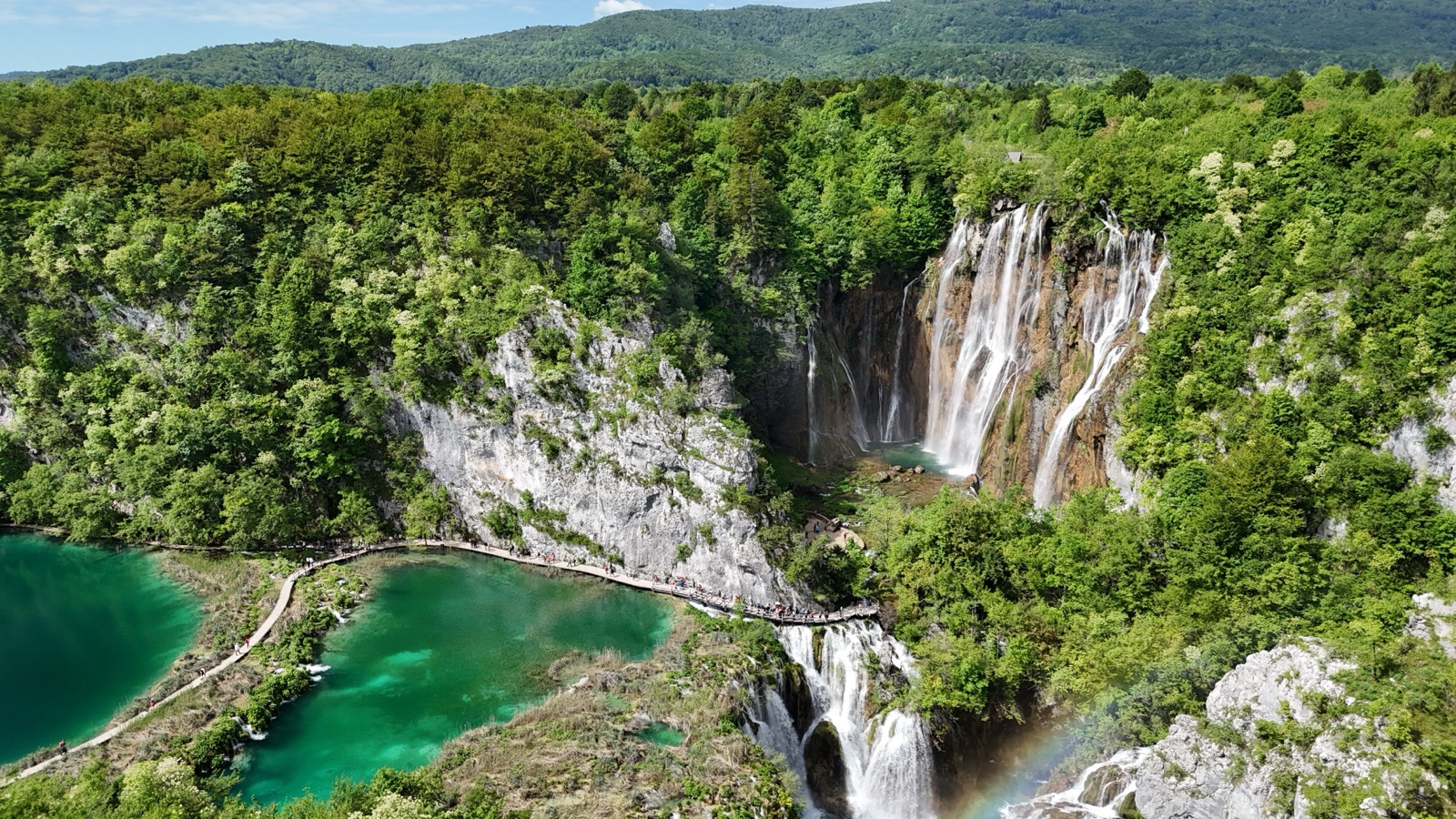
Plitvice or Krka? Croatia's Two Waterfall Parks Compared
If you can see only one, choose Plitvice Lakes for scale and scenery and Krka for convenience from the coast. Plitvice is the bigger and older park: just under 300 km², a UNESCO World Heritage site since 1979, with 16 named lakes stepping down 8 km of forested valley and a Great Waterfall the park measures at 78 to 87 m. Krka covers 109 km² along a river with seven waterfalls, and its showpiece, Skradinski buk, is easy to reach from Šibenik, Split and Zadar in a morning. Neither lets you swim at its main falls: swimming is banned everywhere at Plitvice, and at Krka it is allowed only in a few marked places, never at Skradinski buk.
The short answer
- Choose Plitvice if you want the classic Croatian lake landscape, a full day of boardwalk walking, and you are coming from Zagreb or are happy with a long day from the coast.
- Choose Krka if you are based in Šibenik, Split or Zadar, want a shorter half-day visit, or are travelling with people who cannot walk for five hours.
- Do both if you have time. They are about 114 miles apart by road, which Rome2rio puts at roughly 2 hours 11 minutes, so they belong on separate days.
Plitvice and Krka side by side
| Plitvice Lakes | Krka | |
|---|---|---|
| Area | Just under 300 km² | 109 km² |
| National park since | 1949, Croatia’s first | 1985 |
| What you come for | 16 named lakes linked by waterfalls, over 8 km | Seven waterfalls along the Krka river |
| Signature fall | Great Waterfall, 78 m (the park also gives 87 m to the Korana) | Skradinski buk: 17 steps over 800 m, 45.7 m drop |
| Swimming | Banned everywhere | Only at marked places at Roški slap, Stinice and Pisak, 1 June to 30 September |
| Adult day ticket, 2026 | €10 / €23 / €40 by season | €7 / €20 / €40 by season |
| Summer late-entry ticket | €25 after 16:00 (15:00 in September) | €30 after 15:00 |
| Typical visit | 4 to 8 hours on a lake programme | 2 to 3 hours at Skradinski buk |
| Boats and transfers in the ticket | Electric boat and panoramic vehicles | Skradin boat and Lozovac bus, 1 April to 31 October |
| Nearest big city | Zagreb, 130 km | Split, 89 km to the Lozovac entrance |
The landscapes: lakes against a river
Plitvice is a staircase of lakes. The system runs south to north over 8 km, from Prošćansko jezero at 636 m down to Novakovića Brod at 503 m, with 16 named lakes and several smaller ones cascading one into the next. The twelve Upper Lakes lie on dolomite in open, wooded country; the four Lower Lakes sit in a limestone canyon with steep cliffs. The lakes cover just under 1% of the park, which is mostly forest. You walk beside and over the water on boardwalks for hours, and the colour changes with the light from emerald to deep blue.
Krka is a river with waterfalls along it. The Krka is about 72.5 km long including its drowned mouth, and tufa deposited from the water has built seven waterfalls with a total drop of 224 m. The park is spread out along the river: its sights are not concentrated in one area, and the park itself says the separate places are visited by car, because walking between them would take too long. Most visitors see one place, Skradinski buk, where the Krka and the Čikola spill over 17 steps spread across 800 metres.
Both landscapes are built by the same process. At Plitvice the tufa barriers that hold back the lakes are still growing, at about 13.5 mm a year on average, and UNESCO listed the park for exactly that tufa-forming process. Skradinski buk is the longest tufa barrier on the Krka and in Europe.
The waterfalls
At Plitvice, the Great Waterfall (Veliki slap) is the highest in the park and in Croatia. The park gives its first drop as 62 m and its total height, down to the start of the Korana, as 87 m; other park pages and the Croatian Encyclopaedia give 78 m. It is fed not by the lakes but by the Plitvica stream. Besides it, the lake system has six other waterfalls or cascades higher than 20 m, and Veliki Prštavac, at 28 m, is the highest cascade of the Upper Lakes. The waterfalls article explains them all.
At Krka, Skradinski buk is 200 to 400 metres wide with a total drop of 45.7 metres: lower, but much broader, a wide fan of falls and pools rather than one tall drop. Upstream, Roški slap has a main fall 22.5 m high and many backwaters, cascades and tufa islands, crossed by a 1,360 m circular trail.
In short: Plitvice has the tallest single fall and the most falls in one walk; Krka’s Skradinski buk is the broadest.
Swimming: the deciding question for many
If you have seen pictures of people swimming below Skradinski buk, they are out of date. Krka’s regulations banned swimming in the park from 1 January 2021 to protect tufa deposition, and swimming at Skradinski buk is not allowed. Today swimming at Krka is permitted only in designated areas at Roški slap, Stinice and Pisak, from 1 June to 30 September, at your own risk and depending on weather and water levels.
At Plitvice swimming is not allowed anywhere: the park’s rulebook bans bathing in all its lakes and watercourses, and pets may not be bathed either. If a swim matters, Krka’s marked places are the only option inside either park. Near Plitvice you can swim in the Korana at Slunj, below Rastoke, where the river’s summer water temperature is 24 to 28 degrees by the tourist board’s figures. The swimming article covers the rules and the places nearby.
Tickets and prices in 2026
The two parks price in almost the same three seasons, and the summer peak is identical.
Plitvice, on the park’s 2026 price list, charges adults €10 from January to March and in November and December, €23 in April, May and October, and €40 from June to September. In summer the price drops to €25 after 16:00 from June to August and after 15:00 in September. Children aged 7 to 18 pay €4, €6 and €15; children up to 7 enter free. The ticket is sold for a specific date, entrance and hour, and the number of tickets per hour and entrance is limited.
Krka, on its 2026 price list, charges adults €7 in January, February, March, November and December, €20 in April, May and October, and €40 from June to September, or €30 for entry after 15:00 in those summer months. Children aged 7 to 18 pay €4, €12 or €15. The one-day ticket allows a single visit to all the park’s land sites on the same day, but each site only once: arrive via Lozovac and you cannot come back through Skradin by boat, or the other way round. The ticket is sold at every entrance and reception desk.
What the ticket includes differs. At Plitvice the electric boat on Kozjak and the panoramic vehicles within your chosen programme are included. At Krka the ticket includes the boat from Skradin to Skradinski buk and the bus from Lozovac, both from 1 April to 31 October; the longer boat excursions cost extra. The Plitvice tickets guide has the full details for the Plitvice side.
How long each visit takes
Plitvice is a day. The shortest programmes, A, B and F, take 2 to 4 hours and see only the Lower Lakes. To see both halves you need programme C (4 to 5 hours, 8,000 m) or H (4 to 6 hours, 8,900 m), and the full-day K1 and K2 walks take 6 to 8 hours. The Plitvice tourist board suggests two days for the lakes alone.
Krka can be a half day. Visitors spend 2 to 3 hours at Skradinski buk on average, and the park’s webshop allows 2 hours for the visit, not counting the time to get there. The 1,900 m circuit at Skradinski buk crosses several wooden bridges and takes about an hour and a half. To see more of the river, you add boat excursions or drive between sites.
For a family with young children, or anyone who cannot walk for long, this is often the deciding difference. The one-day itinerary shows how to fit the main Plitvice programmes into a single day.
Getting there
Plitvice is inland, in the hills between Zagreb and the coast. The Plitvice tourist board puts it 130 km from Zagreb (about 2 hours’ drive), 118 km from Zadar and 242 km from Split. FlixBus says the coach takes about 1 hour 50 minutes from Zagreb, 1 hour 30 minutes from Zadar and 3 hours 30 minutes from Split. No railway runs through the area.
Krka is near the coast, just off the A1 motorway above Šibenik. By the park’s distance table, Split is 89 km from the Lozovac entrance and Zadar 81 km. The park lists four entrances: Lozovac, Skradin, Roški slap / Laškovica and Burnum / Puljane. For Skradinski buk you either park at Lozovac, where visitor parking is free, and take the park bus or the 875 m walking trail down, or go to Skradin and take the park boat, a 20-minute ride; parking in Skradin is privately owned and charged. In winter the boats and buses to Skradinski buk do not run, and you drive down from Lozovac or walk from Skradin.
So from Zagreb, Plitvice is the natural day trip. From Split, Krka is much closer; Plitvice is a long day. From Zadar, both are possible: Plitvice is about an hour and a half by coach, Krka a little closer by road. The getting there guide covers the Plitvice routes in detail.
Crowds
Both parks are busiest in summer. Plitvice had 1,492,994 visitors in 2024, with July and August the busiest months, and in summer a resort near the park says crowds peak between 10:00 and 15:00. Its timed tickets spread arrivals through the day, and the tourist board says Entrance 2 is generally less crowded than Entrance 1.
Krka’s park says summer has the most visitors and that in summer the vegetation is at its lushest but visitor numbers are highest. Because most visitors head for Skradinski buk, expect its boardwalk circuit to be at its busiest in the middle of a summer day. At both parks the answer is the same: arrive at opening time, or come in the shoulder months.
Weather and the best season
The two parks have different climates, and it matters in spring and autumn. Plitvice sits at 503 to 636 m in the mountains of Lika. The national met service’s Gospić station, the climate reference for the area, averages -1.6 °C in January and 19.2 °C in July, with snow on about 30 days a year. Krka is close to the coast: at the met service’s Zadar station the January mean is 7.3 °C, July 24.5 °C, and there are no snow days in an average month.
In practice:
- Spring (April and May): Plitvice is at its fullest with snowmelt and the Upper Lakes usually reopen in early April. Krka is warmer and greener earlier.
- Summer: both are busy. Plitvice is the cooler of the two for walking.
- Autumn (October): Plitvice has its famous autumn colours and the €23 ticket. Krka is mild.
- Winter: Plitvice usually opens only the Lower Lakes and can be snowy and icy. Krka stays open, but the boats and buses to Skradinski buk stop. Krka’s park says in winter the abundance of water and the shapes of the rock and tufa are best seen.
The best time to visit guide covers Plitvice month by month.
What else there is to do
At Plitvice, besides the lake programmes, there are four hiking trails, including the Medveđak ridge and the 21 km Čorkova uvala forest trail, rowing boats on Kozjak and, in a snowy winter, the small Mukinje ski slope. The hiking guide covers the trails.
At Krka, the extras are on the water and in history. Boat excursions from Skradinski buk go to Visovac, an island where a Franciscan monastery and church have stood since 1445 (2 hours, €15 for an adult in 2026), and on to Roški slap (4 hours, €20). These can only be booked and paid for in the park, not online. Restored watermills at Skradinski buk demonstrate milling, washing and pounding cloth, weaving and smithing, and the park has 22 educational trails totalling 47 km.
Rules at both parks
The two parks protect the same fragile tufa, so their rules are similar:
- Stay on the marked paths. Walking off the marked footpaths is not allowed at Plitvice, and at Krka you may not walk on the travertine barriers off the marked trails.
- Dogs on a lead. Allowed at both on a lead, but not on Visovac Island at Krka.
- No drones at either park.
- Swimming only at Krka’s marked places in summer, never at Plitvice.
- Footwear: both parks recommend good shoes; Krka’s trails mix boardwalks, gravel and paving.
Tours to each park
From the coast, guided day trips make Plitvice manageable. The guided tour from Split on the tours page lasts about 12 hours and includes entry tickets, the panoramic train and a boat ride, and the tour from Zadar about 10 hours. From Zagreb, the day trip lasts 9–10 hours and adds the watermill village of Rastoke. The tours compared guide weighs time on the road against time in the park for each.
Which one should you choose?
- First trip to Croatia, one park only, a full day free: Plitvice.
- Based in Split or Šibenik, half a day free: Krka.
- You want to swim: Krka, at its marked places between June and September, or the rivers near Plitvice.
- Travelling with small children or limited mobility: Krka’s Skradinski buk circuit is shorter; at Plitvice choose a short Lower Lakes programme.
- Visiting in winter: Krka for comfort and a full visit; Plitvice for snow and ice, with only the Lower Lakes usually open.
- Two days free: do both, one per day.
Frequently asked questions
Is Plitvice or Krka better?
Plitvice is bigger, a UNESCO site and the more spectacular lake landscape; Krka is closer to the coast and quicker to visit. With one day and a choice, most first-time visitors pick Plitvice.
Can you swim at Krka or Plitvice?
Not at Plitvice, where swimming is banned everywhere. At Krka swimming is allowed only at marked places at Roški slap, Stinice and Pisak from 1 June to 30 September, never at Skradinski buk.
Can you visit Plitvice and Krka in one day?
It is not realistic. Rome2rio puts the drive between them at about 2 hours 11 minutes, and each park needs several hours on foot. Plan them on separate days.
Which is cheaper, Plitvice or Krka?
In summer both charge adults €40 for a standard day ticket in 2026. Out of season Krka is slightly cheaper: €7 against €10 in winter, €20 against €23 in spring and autumn.
How far is Krka from Plitvice?
About 114 miles by road, according to Rome2rio, roughly 2 hours 11 minutes’ drive.