Practical
Can You Swim in Plitvice Lakes? The Ban, the Reasons and Where to Swim Nearby
No. You cannot swim in Plitvice Lakes, in any lake, in any season. The park’s protection rulebook, published in Narodne novine, the Croatian state gazette, in 2021, bans bathing in the lakes and watercourses of the national park, which means the streams and rivers as well as the sixteen named lakes. The park’s rules of conduct put it plainly, “Don’t swim in the zone of the National Park”, and its FAQ calls swimming in the lakes strictly prohibited.
The water looks inviting for a reason, and the reason is also why you cannot get in. The lakes are held up by tufa barriers, fragile natural dams that are still growing, and the whole park was put on the UNESCO World Heritage List for the process that builds them. This article sets out exactly what the rules say, why they exist, what you can do on the water instead, and where you can swim legally within reach of the park, from the Korana river at Slunj to the town beaches of Karlovac.
The short answer
- Swimming: banned in all lakes and watercourses in the national park, all year.
- Diving and water sports: underwater activities are banned too, and so are rafting, water-skiing and sailing.
- Dogs: not allowed in the water either. The rulebook bans bathing pets in the lakes, streams and rivers.
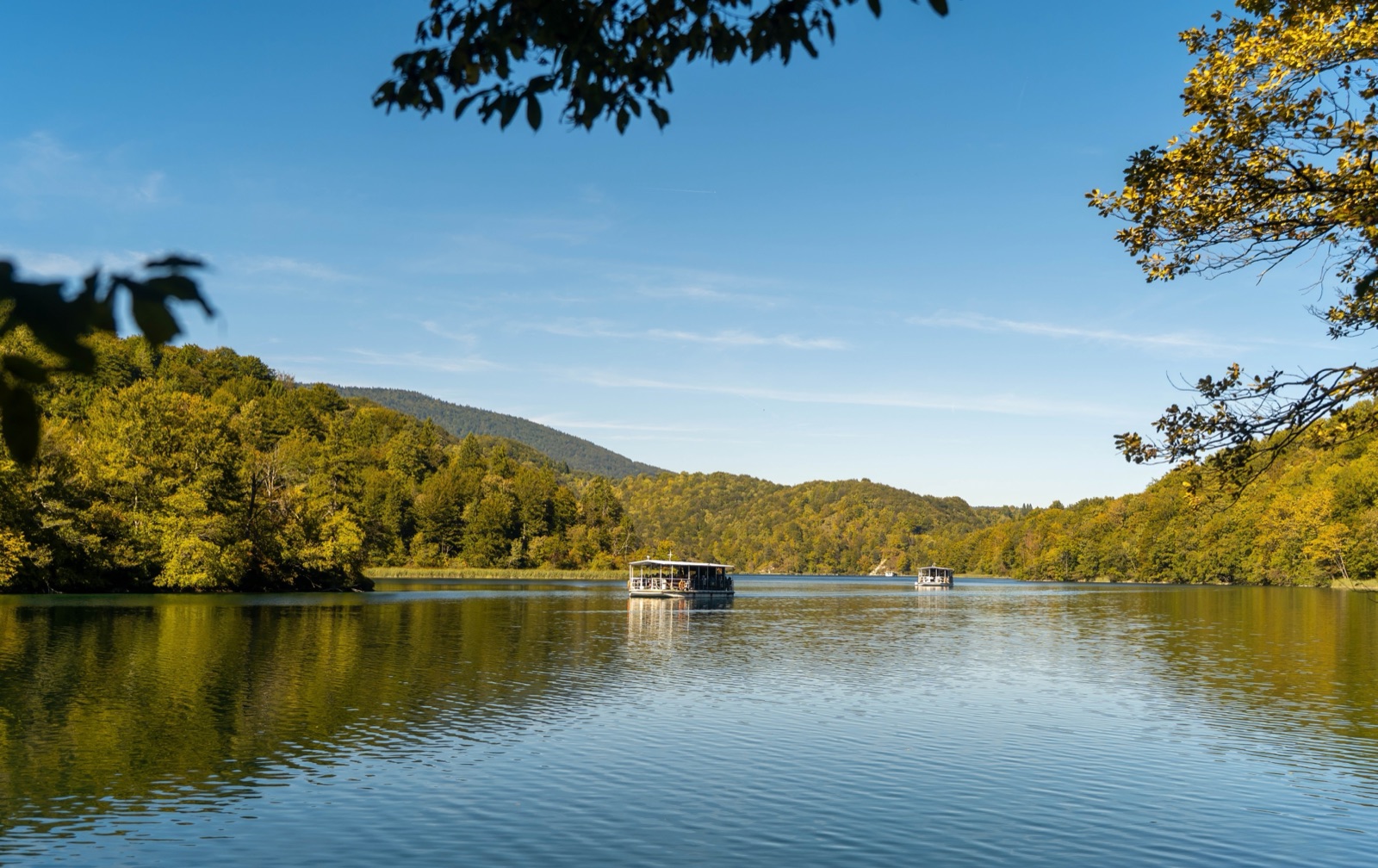
- What is allowed: the park’s electric boats on Kozjak, included in the ticket, and the park’s own rowing boats on Kozjak, hired separately.
- Where to swim instead: outside the park, on the Korana and other rivers and lakes of the region, at places where local authorities allow it.
What the rules actually say
Plitvice’s rules sit in a legal document, the Rulebook on the Protection and Preservation of the national park, issued by the Ministry of Economy and Sustainable Development and published in Narodne novine 80/2021 on 14 July 2021. The English rules of conduct on the park’s website are a summary of it. The parts that matter for anyone thinking about the water are these:
- Article 33 bans bathing in the lakes and watercourses of the national park, and bans underwater activities. The only exceptions to the diving ban are for conservation, research, maintenance, rubbish removal or filming, with permission.
- Article 34 bans rafting, paragliding, water-skiing, rowing regattas and sailing, among other sports.
- Article 24 allows the park’s electric boats for visitors on Kozjak, and recreational rowing only in the park’s own boats, on Kozjak.
- Article 43 bans bathing pets in the park’s lakes, streams and rivers.
- Article 30 allows visitors to move only on the areas and trails marked for sightseeing, which also rules out climbing down to the water’s edge.
The park repeats the message everywhere a visitor might look. Its general information lists swimming in the lakes among the things strictly prohibited, its FAQ answers the question directly, and the Plitvice tourist board says hunting, fishing and swimming are not allowed.
What happens if you swim anyway
The park’s own pages do not publish a fine for swimming. What they do make clear is that the ban is not a polite request. The rulebook is a regulation issued under Article 142 of Croatia’s Nature Protection Act, and under Article 29 visitors must follow it, the instructions on their ticket and on the information panels, and any additional instructions from park staff. The rulebook also gives the park’s rangers the power to close areas to visitors for up to 24 hours.
In practice, expect to be told to get out by the first member of staff who sees you. The park describes itself as being under the highest level of nature protection, and it treats the lakes accordingly. There is no quiet corner where the rule does not apply: the ban covers every lake and watercourse in the park, including the stretch of the Korana inside its boundary.
Why swimming is banned: the tufa barriers
The lakes exist because of tufa, a hollow, porous rock that forms when plants, algae and mosses help deposit the calcium carbonate dissolved in the water. Tufa builds the barriers that dam the valley into a staircase of lakes, and the barriers are still growing: the park estimates the active ones at between 6,000 and 7,000 years old, rising about 13.5 mm a year.
That growth is easy to stop. The park describes tufa as vulnerable to mechanical damage and large dynamic loads because of its fragile structure, and lists falling trees and melting ice among the things that already break barriers. Swimmers getting in and out would have to cross banks and barriers, which is exactly what the rule on staying on the marked paths exists to prevent. The rulebook backs this up from the other side: it bans the extraction of tufa and the removal of rocks from the park, and the rules of conduct forbid damaging the rocks.
Water chemistry matters as much as footsteps. The park names three conditions for tufa to form: water oversaturated with calcium carbonate, a pH above 8.0, and dissolved organic matter below 10 mg of carbon per litre. The barriers are, in other words, sensitive to what is in the water as well as to what stands on them. Our article on the Plitvice waterfalls explains how the barriers grow, drown and break.
Why swimming is banned: the life in the water
The second reason is what lives in the lakes. The park’s waters include three Natura 2000 habitat types, among them the tufa cascades of karst rivers of the Dinaric Arc. Species such as the stone crayfish, the kingfisher and the otter depend on good water quality, and the park reads their presence as a sign that the water is in good condition. The same habitats hold endemic, threatened and strictly protected species, from mosses and dragonflies to the European crayfish, brown trout and the white-throated dipper.
Scale is the third reason. In 2024 the park counted 1,492,994 visitors. The park says Plitvice is under the highest level of nature protection, and with that many people on the boardwalks each year, the rule leaves no room for exceptions.
What you can do on the water
You can still get onto the lakes, just not into them.
- The electric boats. The park’s boats cross Kozjak, the largest lake, at 82 hectares, and the rides are included in the ticket. A short route runs between docks P1 and P2 and a long one between P2 and P3. On a sunny day you can see the drowned tufa barrier in Kozjak from the boat, a pale line in the dark blue water.
- Rowing boats. Rowing is allowed on Kozjak in the park’s boats, hired at dock P1. Each takes 4 people and costs €15 an hour, from 10:00 to 15:00.
- The spray at the Great Waterfall. The park says the fall throws up water dust that gives refreshment on hot days. It is the closest you will get to a cold shower inside the park.
Fishing is not allowed, and neither is paddling your own kayak or inflatable: on the park’s waters only its own boats are permitted for visitors. Our tickets and routes guide explains which programmes include the boat and the panoramic train.
Staying cool on a summer visit
The question usually comes up in July and August, the park’s busiest months. If you are visiting in the heat:
- Go early. You cannot enter before the time on your ticket, so book the first hour available. A resort near the park puts the summer crowds at their peak between 10:00 and 15:00.
- Use the forest. Three-quarters of the park is forest, and the Upper Lakes are wooded all round.
- Bring what the park suggests: a hat, sunglasses and sunscreen in summer, an umbrella or raincoat when the forecast needs it, and suitable shoes for the boardwalks.
- Plan a swim for afterwards. The Korana runs out of the park and, further downstream, has town beaches where swimming is part of summer life.
Where the water goes: the Korana
The water of the lakes leaves the park as a river. At the foot of the last barrier, below Novakovića Brod, it joins the Plitvica stream to form the source of the Korana, which then drops four more times over tufa barriers in its canyon before setting off on a 134 km journey to Karlovac. The rulebook’s ban covers the watercourses of the national park, so the first stretch of the river, inside the park, is off limits too.
Downstream, outside the park, swimming in the Korana is allowed, and two towns on the river have well-kept bathing places: Slunj, with Rastoke, and Karlovac. Both lie on the road between Zagreb and the lakes.
Swimming at Slunj and Rastoke
The closer of the two is Slunj, on the main road from Zagreb to the lakes, the D-1 that the Plitvice tourist board describes running through Karlovac, Slunj, Plitvička Jezera and Korenica. Slunj’s tourist board calls the Korana a true paradise for swimmers, entry to the bathing places is free, and the shallow pools upstream of the town bathing place suit small children. The town also publishes water tests: samples taken at the town bathing place in July 2025 found the Korana still of excellent quality.
Slunj is also home to Rastoke, the watermill village where the Slunjčica falls into the Korana, which the guided day trip from Zagreb combines with the lakes. Our guide to Rastoke and Slunj covers the bathing places, the mills and how to fit them into a Plitvice day. For something colder, the Slunj tourist board points to the Mrežnica, which it describes as an emerald-green river of refreshing temperature.
Swimming at Karlovac
Karlovac is where the Korana’s 134 km journey from the lakes ends, and the Croatian Encyclopaedia gives it as 86 km from the lakes. Its best-known swimming spot is Foginovo Beach, which the Karlovac tourist board describes as the most famous and busiest city beach in the town, and as the first registered river beach in Croatia.
- Entry is free.
- There is a diving tower with 3 m, 5 m and 10 m boards, and shallow water for less confident swimmers.
- Lifeguards watch the swimmers, and there is a lift into the water for people with limited mobility.
- The season is fixed each year. In 2026 the town announced lifeguards every day from 10:00 to 20:00 until 6 September, and said the county public health institute’s latest results rated the Korana as excellent.
Karlovac makes most sense if you are travelling between Zagreb and the lakes by car and want to break the journey.
Lake Sabljaci at Ogulin
If you would rather swim in a lake, a well-known option in the region is Lake Sabljaci at Ogulin, a reservoir on the Zagorska Mrežnica. The Ogulin tourist board calls it the 11th largest lake in Croatia, at 170 ha, and says many people call it the “Ogulin sea”. It describes the lake as open to swimmers, rowers and windsurfers, as well as to anglers. It is a reservoir, not a protected tufa lake, and swimming is part of what it offers.
Pools near the park
If what you want is simply to get into water after a hot walk, a pool is the easy answer. The Plitvice tourist board describes Camp Plitvice, at Smoljanac, a few minutes’ drive from the park’s main entrance, as having a pool for guests to cool off in summer and a children’s pool. It calls it the only five-star campsite in the area, and it is open all year.
Inside the park, Hotel Jezero’s spa zone, free for guests, has a whirlpool, a Finnish sauna and a Turkish steam bath. It is not a swim, but after a cold spring or autumn day on the boardwalks it is the warmest water you will find at Plitvice.
The coast, and Krka’s swimming areas
If it is sea you are after, the Adriatic is the obvious answer: the Plitvice tourist board puts the lakes 118 km from Zadar, and the Croatian Encyclopaedia notes that the lakes are linked to the coast via Otočac, 38 km away.
Many visitors also assume they can swim at Krka, Croatia’s other tufa waterfall park. Only in places: Krka National Park says swimming at Skradinski buk, its best-known waterfall, is not allowed, and that swimming is permitted only in designated areas at Roški slap, Stinice and Pisak, from 1 June to 30 September, at your own risk. Krka is not a short hop from Plitvice: Rome2rio puts the drive at 114 miles, about 2 hours 11 minutes.
Before you swim in a river
Rivers are not swimming pools. A few points apply wherever you get in:
- Swim where swimming is expected: at town beaches and places the local tourist board or town lists, not off a random bank.
- Check the water. Some towns publish water quality results for their bathing spots.
- Respect protected areas. Tufa forms in other rivers of the region too, and the same reasoning that protects Plitvice applies to barriers elsewhere.
- Watch the season. River temperatures and water levels change through the year.
A day with Plitvice and Rastoke
If you want the lakes and a river village in one day without driving, the guided day trip from Zagreb on our tours page includes the park ticket, the boat and train rides inside the park, and the watermill village of Rastoke. It takes 9–10 hours. For every other option, from day trips from Split and Zadar to guided walks at the park, see the full listing on the tours page.
Frequently asked questions
Can you swim in Plitvice Lakes?
No. The park’s rulebook bans bathing in all the lakes and watercourses of the national park, and the park’s FAQ calls swimming in the lakes strictly prohibited. The ban applies all year.
Why is swimming not allowed at Plitvice?
The lakes are held up by tufa barriers, fragile natural dams that are still growing and that the park describes as vulnerable to mechanical damage. Tufa also depends on clean water with very little organic matter, and the lakes are home to strictly protected species.
Can dogs swim in Plitvice Lakes?
No. The rulebook bans bathing pets in the park’s lakes, streams and rivers. Dogs must be on a leash in the park.
Can you go on a boat at Plitvice?
Yes. The electric boats on Kozjak are included in the ticket, and the park’s own rowing boats can be hired at dock P1 for €15 an hour.
Where can you swim near Plitvice Lakes?
Outside the park. The closest well-known spots are on the Korana at Slunj, where the town bathing places are free, and at Foginovo Beach in Karlovac. Lake Sabljaci at Ogulin is a lake option, and Krka National Park allows swimming in designated areas from 1 June to 30 September.