Practical
Plitvice Lakes Weather: Month by Month, Snow, Rain and Frozen Waterfalls
Plitvice Lakes has mountain weather, not coastal weather. The lakes lie between 503 m and 636 m above sea level, in a valley between the Mala Kapela and Lička Plješivica ranges, and the climate that comes with that height is cool, wet and snowy in winter. Of the long records that Croatia’s meteorological service, DHMZ, publishes, the best match for the lakes is Gospić, a town in the same Lika uplands at 562 m. There, the average July temperature is 19.2 °C and the average January temperature is −1.6 °C. At Zadar on the coast the same months average 24.5 °C and 7.3 °C.
Rain is the other big difference. Gospić’s monthly averages add up to roughly 1,500 mm a year, against about 913 mm at Zadar, and the wettest months are October and November. Winter brings snow on about 30 days a year and frosty nights on most days from December to February, and in the coldest spells the Great Waterfall can freeze. This article goes through the numbers month by month, explains why the lakes are so much colder than the coast, and shows how rain, snow, ice and fog change a visit. For crowds, prices and opening hours, see our guide to the best time to visit Plitvice Lakes.
The short answer
- Summer (June to August): mild rather than hot. Average temperatures of 16.9 to 19.2 °C at Gospić, with 19 days reaching 25 °C in July and in August, and only a handful reaching 30 °C.
- Autumn (September to November): the wettest season, with 186 mm in October and 191 mm in November on average, and fog on 6 or 7 days a month.
- Winter (December to February): below or close to freezing on average, snow on 6 or 7 days a month, and frosty nights on most days. The Upper Lakes usually close.
- Spring (March to May): snowmelt and rain keep the water high. The Upper Lakes usually reopen in early April, weather permitting.
- All year: pack a rain layer. Even July, the driest month, averages 71 mm of rain at Gospić.
Where the numbers come from
The park has its own automatic weather station. It measures air temperature, wind direction, precipitation and soil temperature, and sends the data every day to DHMZ in Zagreb. DHMZ does not publish that station’s long-term averages on its public climate pages, though, so the figures in this article come from the published station that best matches the lakes: Gospić.
Gospić is a fair stand-in. It is a town in Lika and the seat of Lika-Senj County, the county that holds 90.7% of the national park, and it stands at 562 m, inside the altitude range of the lakes themselves. DHMZ gives its averages for the period 1872–2024. To show the contrast with the coast, the table also gives DHMZ’s averages for Zadar over 1961–2024.
Treat the Gospić figures as a guide to Plitvice, not a measurement of it. Gospić stands in the open Lika plain, the lakes in a forested valley, and local conditions can differ.
Plitvice weather month by month
Average values from DHMZ. Temperature in °C, precipitation in mm, and the average number of days a month with rain, snow or fog.
| Month | Gospić mean temp | Gospić rain and snow (mm) | Days with rain | Days with snow | Days with fog | Zadar mean temp |
|---|---|---|---|---|---|---|
| January | −1.6 | 115 | 8 | 7 | 6 | 7.3 |
| February | −0.3 | 114 | 7 | 6 | 4 | 7.8 |
| March | 3.9 | 111 | 9 | 5 | 2 | 10.0 |
| April | 8.6 | 119 | 12 | 2 | 1 | 13.4 |
| May | 13.2 | 111 | 12 | 0 | 2 | 17.9 |
| June | 16.9 | 96 | 11 | 0 | 2 | 21.9 |
| July | 19.2 | 71 | 8 | 0 | 2 | 24.5 |
| August | 18.4 | 83 | 8 | 0 | 3 | 24.1 |
| September | 14.1 | 136 | 10 | 0 | 6 | 20.2 |
| October | 9.3 | 186 | 12 | 1 | 7 | 16.3 |
| November | 4.5 | 191 | 12 | 3 | 6 | 12.1 |
| December | 0.2 | 165 | 10 | 6 | 7 | 8.6 |
These are averages of whole days, nights included. Afternoons in summer are warmer than the July mean suggests, and nights in every season are colder.
Why it is so much colder than the coast
The short answer is height and distance from the sea. The lakes run from 636 m at Prošćansko jezero down to 503 m at Novakovića Brod, and the hills around them climb higher: the park’s ski slope at Mukinje rises from about 640 m to about 700 m, and the Medveđak peaks above Kozjak reach 868 m. The coast is not far in distance, since the Croatian Encyclopaedia notes that the lakes connect to it through Otočac, 38 km away, but it is a different climate.
The table shows the result. Every month at Gospić is about 5 to 9 degrees colder on average than the same month at Zadar. Zadar records no days with snow in an average year and only about 3 with fog; Gospić has about 30 days with snow and 48 with fog. So if you are combining the coast with the lakes, the clothes that suit an evening in Zadar will not suit a morning on the boardwalks.
Winter: snow, ice and frozen waterfalls
From December to February the average temperature at Gospić sits around or below freezing. The averages tell the story of a cold, snowy winter:
- Frosty nights: the minimum drops below 0 °C on 25 days in an average January, 21 in February and 22 in December.
- Days that never thaw: the temperature stays below freezing all day on 10 days in January and 7 in December.
- Hard frosts: the minimum falls to −10 °C or lower on 7 days in January and 6 in February. DHMZ’s coldest readings at Gospić are −33.5 °C in February 1956 and −32.6 °C in January 1942.
- Snow: snow falls on 7 days in January, 6 in February and 6 in December. The deepest snow DHMZ has recorded at Gospić was 285 cm, on 16 February 1929.
This is when Plitvice’s most unusual sight appears. The park says that in the cold winter months temperatures sometimes drop so low that the Great Waterfall freezes. It does not happen every winter, so do not plan a trip around it, but a cold spell after a snowfall gives you the best chance.
Winter also shrinks the park. The Lower Lakes are usually open and the Upper Lakes closed, and on the park’s winter page the electric boat and the panoramic train ran on shorter timetables: the short boat route from 8:00 to 16:00 and the train from St2 to St3 from 8:00 to 15:00. When there is enough natural snow, the park opens the small Mukinje ski slope near Entrance 2. Our best time to visit guide covers what else changes in winter.
Ice on the boardwalks
Snow and frost matter most underfoot. The boardwalks run over water and wet ground, and on frosty mornings they can be slippery long after the air has warmed. The park’s current-conditions page recommends adequate footwear, and in winter that means shoes with a real grip, not trainers.
Ice is also hard on the lakes themselves. The park lists melting ice in spring among the things that can break tufa barriers, and says that sudden large changes in temperature can crack them. Its rulebook also allows paths to be closed in deep snow or a blizzard.
Spring: snowmelt and high water
March still averages only 3.9 °C at Gospić, with snow on 5 days and frosty nights on 18. April warms to 8.6 °C and is one of the wetter months of the first half of the year, at 119 mm, with rain on 12 days.
This is when the water is at its liveliest. Snowmelt and rain fill the lakes and the falls, and the park says the Great Waterfall is at its most magnificent in spring and autumn. The same water can be destructive: the park notes that great oscillations in water level from melting snow and heavy rain can crack a tufa barrier or break part of it off.
The Upper Lakes usually reopen in early April, but the park says the date depends on the weather. If your trip is in late March or early April, check the current-conditions page before you book the longer programmes.
Summer: mild days, cool mornings
Summer at Plitvice is warm, not hot. The average temperature at Gospić is 16.9 °C in June, 19.2 °C in July and 18.4 °C in August. The afternoon reaches 25 °C on about 19 days in July and 19 in August, and 30 °C on only 5 or 6. Early mornings, the best time for the boardwalks, can feel cool.
July is the driest month, at 71 mm, but summer is not dry: rain falls on 8 to 11 days a month from June to August. The park’s hiking advice lists thunderstorms among the reasons not to set off on a trail, so watch the sky if you are heading for the Medveđak peaks. Summer sun is strong, too, and the park suggests sunglasses, a hat and sunscreen alongside the umbrella. July is also the sunniest month at Gospić, with about 313 hours of sunshine.
Autumn: colour, rain and fog
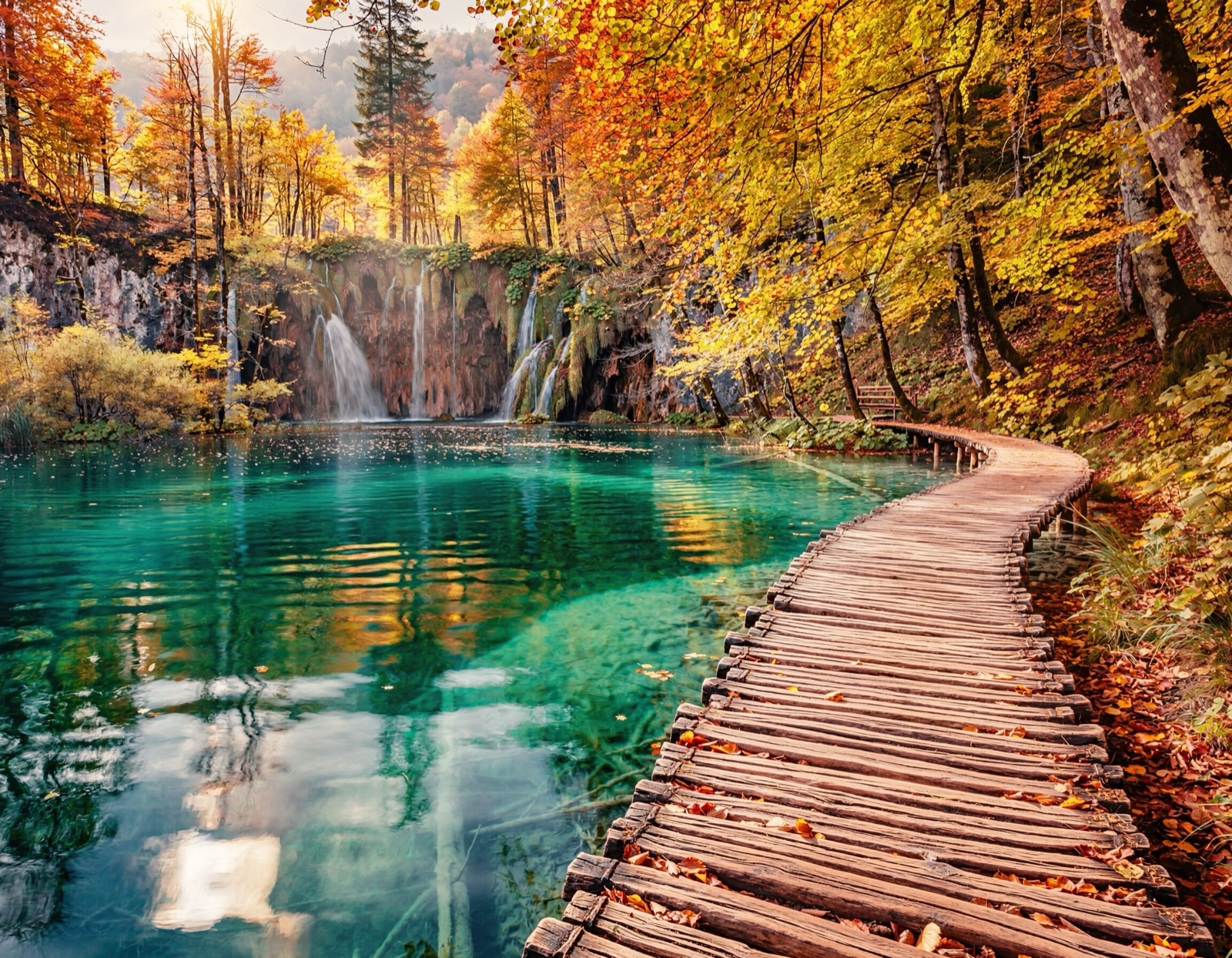
Autumn is the season most visitors photograph and the wettest of the year. October averages 186 mm and November 191 mm at Gospić, with rain on 12 days in each. The park’s own pitch for autumn is its colours, and three-quarters of the park is forest, so a dry, bright day in October can be the best of the year.
Temperatures fall quickly. The September mean is 14.1 °C, October 9.3 °C and November 4.5 °C, and by November the minimum dips below freezing on 13 days. Snow is possible: Gospić averages 1 day with snow in October and 3 in November.
Fog is the other autumn feature. Gospić records fog on 6 days in September, 7 in October and 6 in November. A misty morning can be beautiful on the lakes; it is less good if you have climbed to a viewpoint. The park notes that from Turčić, in good weather, the view reaches Bjelolasica, the highest mountain of the Velika Kapela range.
Rain and the lakes
Rain is not just a nuisance at Plitvice; it is part of how the lakes work. The park says tufa has formed only in periods with a warm and wet climate, similar to today’s, and the lakes depend on the rivers and streams that feed them. The water you see spilling over the barriers after a wet week is the same process that built them.
For a visitor, rain changes three things:
- The falls: after heavy rain the waterfalls carry more water and look more powerful.
- The paths: boardwalks and forest paths get wet and slippery, and the rulebook allows the park to restrict or close access in a flood.
- The light: the park says the colour of the lakes depends partly on the weather and the play of light and shadow, so a grey day gives you different, softer colours rather than none. Our article on Plitvice Lakes photos goes into the light in detail.
How the weather can close the park
The park has clear rules for bad weather. It warns that weather in the park changes quickly, so individual trails may be closed temporarily or the vehicles stopped. Under Article 31 of its rulebook, in exceptional circumstances such as a flood, deep snow, a blizzard, a collapsed path, fire or the removal of rock or trees, visitor movement can be restricted or banned for safety. The park’s rangers can close or restrict areas for up to 24 hours; the director can do so for up to 15 days.
Before you go, check the park’s current-conditions page, which shows whether the Upper and Lower Lakes are open and whether the panoramic vehicles and electric boats are running. The park also recommends phoning ahead. If the park closes because of extreme weather, tickets are refunded in full. For the rules on time slots and changes, see our tickets and routes guide.
What to wear and bring
The park’s own advice covers most of it: comfortable clothing and footwear suitable for various terrains and weather conditions, rain protection such as an umbrella or raincoat, sun protection depending on the season, and a look at the weather forecast before you set off. By season, that means:
- Winter: warm layers, a hat and gloves, waterproof boots with good grip.
- Spring and autumn: a waterproof jacket, a warm layer for the morning and shoes that cope with wet boardwalks.
- Summer: light clothes plus one warm layer for the early morning or the boat, a hat and sunscreen, and a raincoat for the afternoon storms.
If you plan to walk one of the park’s hiking trails rather than the lake boardwalks, the park asks for mountain hiking clothes and shoes, and says not to set off if the forecast is bad: snow, heavy rain, thunderstorms or strong wind.
Weather and tours
A day tour does not change the weather, but it does take the timing off your hands. The guided day from Zagreb on our tours page includes the park ticket, the boat and train rides and the watermill village of Rastoke, in 9–10 hours. On a hot summer day, the early-morning tour enters at opening time with a licensed local guide, when the boardwalks are coolest and quietest. In winter, ask any tour what happens if the boats or the Upper Lakes are closed, and see our guide to Plitvice Lakes tours for how the options compare. If you are driving yourself in winter, our guide to getting to Plitvice Lakes covers the roads in.
Frequently asked questions
What is the weather like at Plitvice Lakes?
Cooler and wetter than the coast. At DHMZ’s Gospić station in Lika, the best-matched station it publishes, the average temperature runs from −1.6 °C in January to 19.2 °C in July, and the monthly averages add up to roughly 1,500 mm of rain and snow a year.
Does it snow at Plitvice Lakes?
Yes. Gospić averages about 30 days with snow a year, mostly from December to March. The park opens its Mukinje ski slope when there is enough natural snow, and usually keeps the Upper Lakes closed in winter.
Do the waterfalls at Plitvice freeze?
Sometimes. The park says that in the cold winter months temperatures sometimes drop so low that the Great Waterfall freezes. It needs a hard cold spell, so it does not happen every winter.
What is the rainiest month at Plitvice?
November, closely followed by October: 191 mm and 186 mm on average at Gospić. July is the driest month, at 71 mm.
Is it hot at Plitvice in summer?
Not usually. The July average at Gospić is 19.2 °C, and the temperature reaches 30 °C on only about 5 or 6 days in July and in August. Mornings can be cool, so bring a layer.