Places
Plitvice Lakes Photos: The Classic Viewpoints and When the Light Is Best
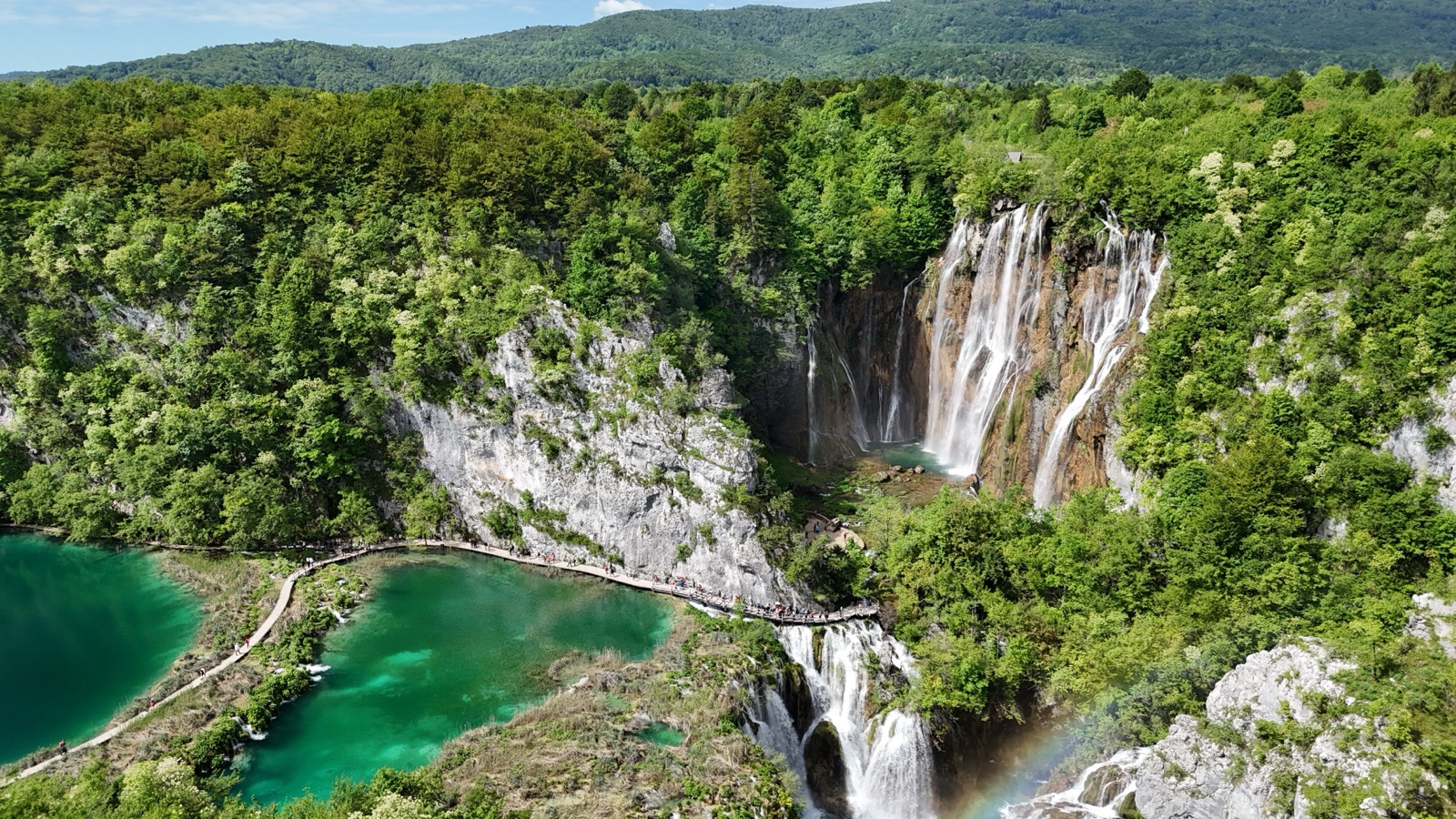
Most of the famous Plitvice Lakes photos come from a handful of places. The best known is the view from the east rim of the Lower Lakes canyon: the Great Waterfall coming down the cliff, turquoise pools below and a thin line of boardwalk with people on it. The rest are taken on the boardwalks themselves, over the Lower Lakes in the canyon and the Upper Lakes in the forest, from the electric boat on Kozjak, and from a few high viewpoints off the lake trails.
All of them are on the park’s ordinary programmes, and photos for your own use need no permit. What decides how your pictures turn out is mostly timing: the hour you enter, the season and how many people share your stretch of boardwalk. This article covers the classic viewpoints, the programmes that pass them, the light and the seasons, and the park’s rules for photographers, which are stricter than many visitors expect.
The shot list at a glance
- The canyon overlook: the Great Waterfall and the Lower Lakes from the viewpoints on the east side of the canyon. Programmes A, B, F, H and the K routes pass them.
- The foot of the Great Waterfall: close up, in the spray, on a path used in both directions.
- The Lower Lakes boardwalks: Novakovića Brod, Kaluđerovac, Gavanovac and Milanovac, with the Milka Trnina waterfall between the last two.
- Kozjak from the water: the largest lake, seen from the electric boat or a rowing boat.
- The Upper Lakes boardwalks: Galovac, the Prštavci falls and the forest-edged lakes up to Prošćansko jezero.
- High viewpoints: Tomićevo pogledalo above the top lakes, and the Medveđak peaks above Kozjak.
- What you cannot take: your own aerial shots. The park bans drones.
The overlook above the Lower Lakes canyon
The picture that sells Plitvice is a view down into the canyon of the Lower Lakes. The four Lower Lakes formed in limestone and lie in a deep canyon with steep cliffs, and at its north end the Great Waterfall comes down the canyon wall. Seen from above, the fall, the pools and the boardwalks fit into one frame.
The park’s route descriptions tell you where to stand. On programme F, a steep zigzag path climbs from the Great Waterfall to the east side of the canyon, where there are numerous viewpoints with views of the crystal-clear, dark blue lakes and the high cliffs beside them. Several programmes use that rim:
- Programme A walks up the canyon floor to Kozjak Bridge, then climbs to the eastern side of the canyon and returns along it to Entrance 1.
- Programme B finishes with a walk along the top of the canyon’s east side back to Entrance 1.
- Programme F reaches the rim by the zigzag path from the foot of the Great Waterfall.
- Programme H and the K routes also include a walk along the top of the east side.
The rim is at the Entrance 1 end of the park, so from the north entrance you reach it quickly; from Entrance 2 it comes late in the route. The hero image at the top of this page is an aerial photograph, a view you cannot take yourself, but the rim viewpoints give you much of the same composition from solid ground. For how the fall forms and why sources give it different heights, see our article on the Plitvice waterfalls.
At the foot of the Great Waterfall
From the bottom, the Great Waterfall is a different subject: too tall to fit easily in one frame. The park gives its first drop as 62 m. The fall throws up a fine mist of water, which the park describes as water dust that gives refreshment on hot days. It is welcome in July and less welcome on a lens, so keep a dry cloth in a pocket and wipe between shots.
The path is the other thing to plan for. It cannot be walked in a loop, so everyone who goes in comes back the same way, and the park recently doubled the width of a 93 m stretch from 1.3 m to 2.6 m because of the two-way traffic. Expect people in the frame and keep your stop short at busy times. On the way back, programme F and others take the zigzag path up to the rim, so you can photograph the fall from below and then from above within the same walk.
The boardwalks of the Lower Lakes
Programme A follows the canyon upstream along the lakes Novakovića Brod, Kaluđerovac, Gavanovac and Milanovac. This is where the boardwalks run right over the water and the classic “path across a turquoise lake” pictures are made. The park describes the colours in the canyon as turquoise and deep blue shades, and its programme notes call these the dark blue lakes of the Lower Lakes.
Three subjects reward slowing down:
- The Milka Trnina waterfall, between Milanovac and Gavanovac, is a tufa cascade where the water fans out over moss. It is the only set of waterfalls named after a famous person, the opera singer whose 1898 donation paid for viewpoints and bridges over the lakes.
- The Great Cascades, the tufa barriers over which Gavanovac flows into Kaluđerovac, have a footbridge across them, a ready-made foreground. The park’s handbook for guides counts them among the most impressive falls in the Lower Lakes canyon.
- Sastavci, at the end of the canyon, is where the lakes leave over the last falls and the Korana river begins. Programme B passes both the Great Waterfall and the Sastavci falls.
The canyon is also on the side most people start from: 61% of visitors entered at Entrance 1 in 2024. The early slots matter most here.
Kozjak from the water
Kozjak is the largest lake, at 82 hectares, and the only one with tourist boats. The electric boats are included in the ticket, and a crossing gives you open views down the lake that you do not get from the shore. On a sunny day, look down as well as out: the park says the submerged tufa barrier in Kozjak, the remains of the dam that once split it into two lakes, can be seen from the boat as a pale line in the dark blue water.
For a lower, slower angle, rowing is allowed on Kozjak. Boats are hired at dock P1; each takes 4 people and costs €15 an hour, from 10:00 to 15:00. The park’s rulebook allows recreational rowing only in the park’s own boats, on Kozjak alone.
The long K programmes walk the west shore of Kozjak on the way out and return along the east shore after a short boat ride, which gives you the lake from both sides.
Galovac and the Upper Lakes
The twelve Upper Lakes sit on dolomite. They are larger than the Lower Lakes, with gentler shores, and wooded all round, so the pictures here are of water and forest rather than cliffs. The park writes that on the wooden paths around the Upper Lakes, enclosed by forest, the water looks emerald green.
- Galovac, one of the larger Upper Lakes at 0.12 km² in the Croatian Encyclopaedia’s figures, gives its name to the cascade Galovački buk.
- The Prštavci falls are, in the park’s words, the biggest and most beautiful waterfalls of the Upper Lakes. Veliki Prštavac is a 28 m cascade.
Programme E covers this section in 2 to 3 hours: a short boat ride across Kozjak, then a walk upstream past the Great and Small Prštavci falls to Prošćansko jezero, and the panoramic train back. Programmes C and H add the Lower Lakes. Remember that the Upper Lakes are usually closed in winter and reopen, weather permitting, in early April.
High viewpoints off the boardwalks
The lake trails keep you close to the water. For a wider view you have to climb.
- Tomićevo pogledalo, opened in 2024 at an altitude of 684.82 m, looks over five Upper Lakes: Prošćansko, Ciginovac, Okrugljak, Veliko and Malo jezero. The K programmes pass it.
- Tupi Medveđak (868 m), on the Medveđak ridge, looks over six lakes, Kozjak and Galovac among them.
- Turčić (801 m), the lowest of the three Medveđak peaks, looks over Kozjak, the Great Waterfall, Hotel Jezero and the villages of Poljana and Plitvica.
The Medveđak peaks are on hiking trails, not boardwalks: trail no. 1 starts at the Hladovina car park at Entrance 2. The park also notes that programmes C and H give panoramic views from high viewpoints. Our article on the Plitvice Lakes map shows where each viewpoint sits; for any hiking trail, the park’s advice is to carry a trail map.
The light through the day
The park is candid that its lakes never look the same twice. It says they show a spectrum of colours at any time of day, and that the colours depend on dissolved organic matter, the organisms in the water, depth and surroundings, and also on the weather, the play of light and shadows and the movement of the surface water. For a photographer, the last three are the ones you can work with.
Early morning is the time most photographers want, for calm water and empty boardwalks. You cannot enter before the time on your ticket, so book the first hour available at your entrance. On the park’s hours page, checked on 3 October 2026, the entrances opened at 07:00; in winter the park lists ticket sales from 8:00. The early-morning guided walk on our tours page is built around entering at opening time and reaching the Great Waterfall in morning light.
The middle of the day is the crowded part. A resort near the park puts the summer peak between 10:00 and 15:00, and that is when the boardwalks are fullest. If you have to shoot then, the Upper Lakes from Entrance 2 are usually the quieter half.
Late afternoon is cheaper in summer, at €25 instead of €40 after 4 p.m. from June to August, and after 3 p.m. in September. Watch the transport: on the October timetable the last long-route boat from P2 to P3 left at 16:30 (17:00 in the other direction, from P3 to P2), and the last panoramic vehicle from St3 to St2 at 17:30.
Cloud and rain are not a lost day. The park’s list of water colours runs from emerald green and deep blue to turquoise and light grey, and a soft, even light keeps bright water and dark forest within one exposure.
The seasons in pictures
Each season gives Plitvice a different look, and the park itself points to some of them.
- Spring: the park says the Great Waterfall is at its most magnificent in spring and autumn. The Upper Lakes usually reopen in early April, and from 1 April to 31 May an adult ticket costs €23.
- Summer: every boat and train runs and the forest is at its greenest, but July and August are the busiest months of the year.
- Autumn: the park sells autumn on its colours, and three-quarters of the park is forest. In October the ticket is €23 again and the Upper Lakes are normally still open.
- Winter: in the cold months the temperature sometimes drops so low that the Great Waterfall freezes, which the park calls an unforgettable sight. The Lower Lakes are usually open and the Upper Lakes closed, and the ticket costs €10.
Our guide to the best time to visit Plitvice Lakes covers crowds and prices, and our article on Plitvice Lakes weather has the temperatures, rain, snow and fog month by month.
Why the water looks the way it does
The colour of the lakes is the reason most people bring a camera, and it is worth understanding before you edit your pictures. The park lists the factors above, depth among them; the tourist board adds that as tufa is deposited it coats the beds and banks of the lakes, giving the water its sparkle. So the colour shifts within a single lake as well as between lakes: shallow water over a barrier does not look like the deep water in the middle.
The two halves of the park also differ. The park describes the Upper Lakes, in their forest, as emerald green, and the canyon of the Lower Lakes as turquoise and deep blue. The tourist board, for its part, sums up all sixteen as lakes of crystal blue-green water.
What the park does not do is tie particular colours to particular months. It says the colours vary from lake to lake, within each lake and from one day to the next, and that the lakes never look the same as the day before. If your pictures from two days look different, that is the lakes, not your camera.
Getting a clean frame
Crowds are the main problem for photographers at Plitvice, and the ticketing system helps you manage them.
- Timed entry. Tickets are sold for an hour and an entrance, and the number for each hour is limited. In summer the morning slots online usually sell out days in advance, according to a resort near the park, so book early.
- The quieter entrance. In 2024, 39% of visitors started at Entrance 2. Programme E goes from there by boat straight into the Upper Lakes.
- Two days. A two-day ticket, or a stay at the park’s hotel or campsites, lets you return at the best hour instead of shooting everything at once.
- Patience on the boardwalk. Wait for a gap rather than stepping off the path to avoid people. Leaving the marked trails is not allowed.
The park’s rules for photographers
- Personal photos are fine. The park’s FAQ says taking photos for personal use is permitted.
- Commercial work needs approval. The park’s rulebook, published in Narodne novine 80/2021, bans filming or photographing for commercial purposes without the park’s approval. Under the park’s protocol, requests go in at least 20 days ahead, permit holders move through the park only in the company of a ranger, and the fees are €130 for 1 hour of photography or filming, the same €130 for a whole day of photography, and €400 for a day of filming, plus €20 an hour for the ranger and the entrance ticket on top.
- No drones. The rules of conduct ban remotely controlled aircraft for filming from the air, and the rulebook allows drone filming only in exceptional cases with the park’s approval.
- Stay on the marked paths. The rulebook allows movement only on the areas and trails marked for sightseeing. Do not step onto tufa barriers for an angle; tufa is fragile, and damaging the rocks is forbidden.
- Keep it down. The rules ask visitors not to shout and not to disturb the animals, and the rulebook sets noise limits of 50 dB by day and 40 dB at night outside the settlements.
- Take your rubbish away. There are few bins on the lakeside trails, because animals searching for food at night would get at the scraps.
Tripods are not mentioned in the rules of conduct or in the park’s photography protocol. On a boardwalk with two-way traffic, though, a tripod blocks the path for everyone else, so keep it compact and use it only where there is room to step aside. If in doubt, ask at the entrance. The protocol also lists walking on tufa barriers among the reasons the park refuses a commercial shoot, which tells you how seriously it takes the barriers.
What to bring
Start with the park’s own list: suitable clothing and footwear, an umbrella or raincoat, and sun protection depending on the season. Check the forecast before you set off. Add a cloth for the spray at the Great Waterfall and a bag to keep your camera dry on the boat. Swimming is not allowed anywhere in the park, so there is no reason to take your camera near the water’s edge; our article on swimming at Plitvice explains the ban and where you can swim nearby.
Photo walks with a guide
If you would rather not plan the timing yourself, two guided walks on our tours page suit photographers:
- The early-morning tour enters at opening time with a licensed local guide and walks the boardwalks past the lakes to the Great Waterfall before most visitors arrive. It takes 4 hours.
- The guided walk at the park meets you at Plitvice for a 4-hour walk through the Lower and Upper Lakes, with your ticket reserved, a train or shuttle transfer and a 15-minute boat ride.
Our guide to Plitvice Lakes tours compares these walks with the day trips from Zagreb, Split and Zadar.
Frequently asked questions
Where is the famous Plitvice viewpoint?
The best-known view, of the Great Waterfall and the Lower Lakes from above, is from the viewpoints on the east side of the Lower Lakes canyon. Programmes A, B, F and H and the K routes all walk along that rim; from Entrance 1 you reach it quickly.
Can you fly a drone at Plitvice Lakes?
No. The park bans remotely controlled aircraft for filming from the air. Its rulebook allows aerial filming only in exceptional cases with the park’s approval.
Do you need a permit to take photos at Plitvice?
Not for personal photos. Photography or filming for commercial use needs the park’s approval: the request should go in at least 20 days ahead, and the park charges for the shoot and for the ranger who accompanies it.
What is the best time of day for photos at Plitvice?
Early morning, at the first entry hour your ticket allows, for calm water and empty boardwalks. The busiest hours in summer are between 10:00 and 15:00.
When does the Great Waterfall look best?
The park says it is at its most magnificent in spring and autumn. In cold winters it sometimes freezes.