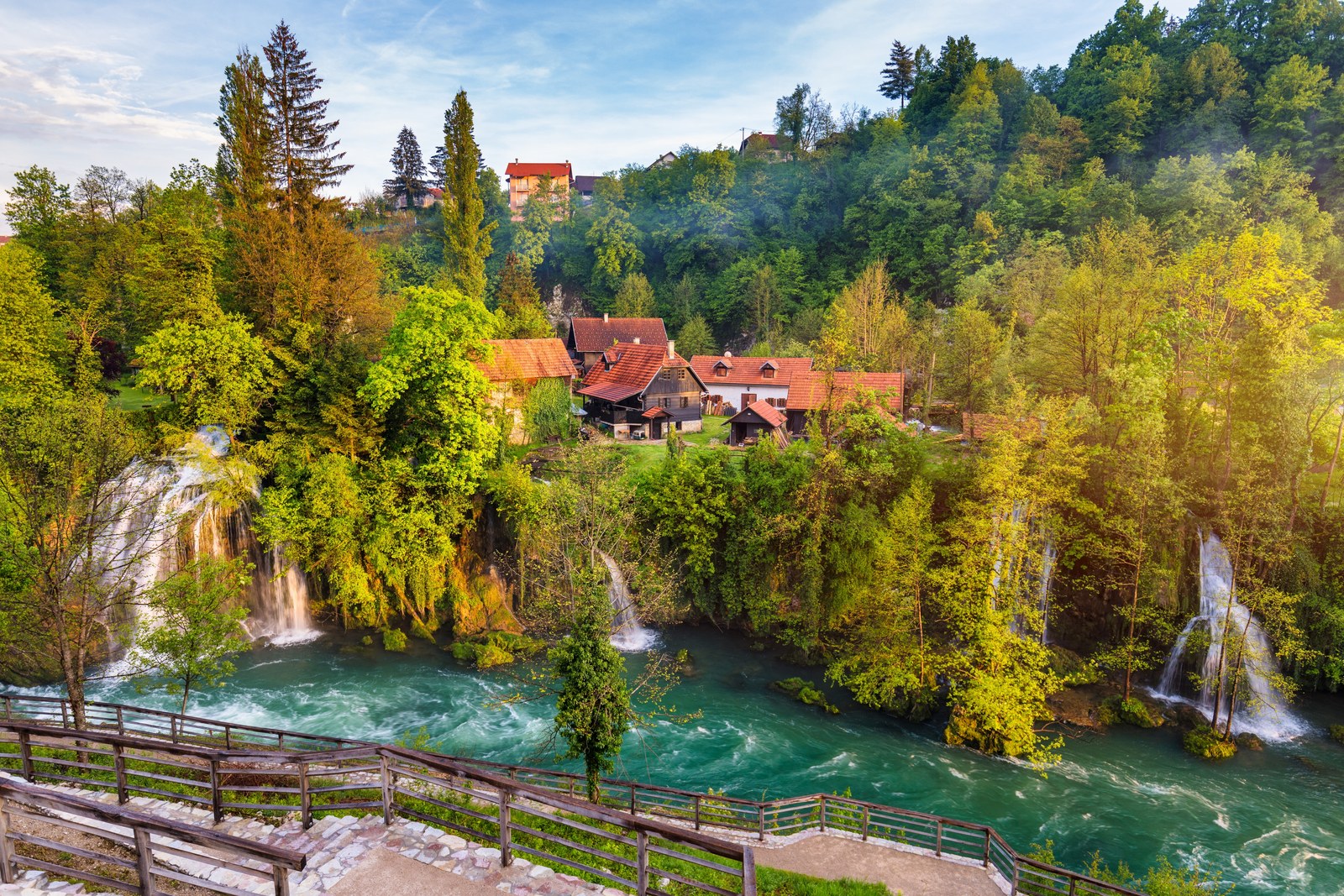
Rastoke and Slunj: The Mill Village on the Road to Plitvice
Rastoke is the old mill quarter of Slunj, a small town in Karlovac County on the main road from Zagreb to Plitvice Lakes. Here the Slunjčica river splits and flows over many travertine waterfalls into the Korana, and the houses and mills stand on top of the falls. The Slunj tourist board puts the town 104.38 km from Zagreb and 32.49 km from Plitvice Lakes, so Rastoke fits into a day at the lakes, and the guided day trip from Zagreb on the tours page stops there.
A visit is partly free. Walking into Rastoke and back along the promenade costs nothing; the circular walk on the Vodene Tajne path, across the new bridge and into the Korana canyon, needs a ticket, which the tourist board’s ticket page, published in August 2023, gives as €5. Allow 1 to 3 hours.
Rastoke at a glance
- Where: part of the town of Slunj, Karlovac County, on state road no. 1, 32.49 km from Plitvice Lakes.
- Ticket: in and back free; the circular walk €5 on the 2023 ticket page, cards only at the kiosks.
- Private estates: Slovin Unique Rastoke charges its own fee and is closed on Tuesdays and in winter; the Jareb family’s mill sells flour.
- Swimming: allowed in the Korana at Slunj, unlike at Plitvice, with free entry to the bathing places.
Where Rastoke is
Slunj sits where two rivers meet. The Slunjčica, a short, cold river that locals also call the Slušnica, falls into the Korana, the larger river that rises at Plitvice. The medieval town stands in a bend of the Slunjčica, and Rastoke spreads over the rocks and islands where the smaller river breaks into channels; the name itself generally refers to the branching of rivers.
The Korana begins below the Sastavci falls at the northern end of the national park, runs 134 km to Karlovac, and on the way receives water from many streams, most notably from the Slunjčica and the Mrežnica, in the park’s own words. The water tumbling through Rastoke joins the river that leaves the lakes; the article on the Plitvice waterfalls explains where the Korana begins.
How the waterfalls form
Rastoke is built on travertine, the porous limestone that the park calls tufa and that builds the barriers between the Plitvice lakes. The Slunj tourist board says the Slunjčica carries dissolved limestone and deposits it on the travertine plateau, making it ever bigger. Over the plateau the river spreads into a multitude of waterfalls, rapids, small lakes and cascades before it drops into the Korana.
Many visitors call Rastoke the small Plitvice Lakes, the tourist board notes. The difference is that at Plitvice visitors must keep to the marked paths and may not damage the rocks, while at Rastoke people built on them: families have lived here for hundreds of years, in houses and mill rooms directly over the falls.
How the mills worked
The Rastoke mills are not the familiar mill with a wheel on the outside wall; the tourist board describes a more complex piece of engineering, organised entirely around the fall of the water.
- The site. A mill was built where there was a drop and enough water. The mills stood on a travertine barrier at the edge of the land, where the falls were 3 to 5 metres high, with the water chute set at an angle of 35 degrees.
- Taming the water. Dams of oak or chestnut, called “heads”, were set across the flow to protect the mill from the direct force of the river and redirect it. Planks of fir or spruce, narrowing towards the bottom, made the water strike the blades harder.
- The drive. The falling water hit the blades directly and turned a vertical spindle, which drove the millstone in the room above the water.
- The building. Stone bases were made of local tufa from the Slunjčica or of quarry stone, and the wooden parts of oak or chestnut, which last longer in water. Tufa deposited by the river sealed the lower rooms, so the inside of the mill stayed dry even in the biggest floods.
- The millstones. Different stones ground different grains: white flour needed a millstone of pure stone and granite, while oats, barley, millet and corn were ground on lower-quality stones. In the busy milling season the stones had to be honed every 8 to 10 days, and every 15 days in the quieter one.
The water did more than grind. Long before washing machines, laundry was washed in baskets beside the mills: deep wooden barrels with drilled holes in which the water tossed the washing until it was clean.
Water was also something to share. A miller’s memories published by the tourist board recall that in families with more than one heir, each heir had the right to a set amount of milling: in the Žalac family the grandfather had two weeks and each son one. Digging and changing the water flow was not allowed, because it caused quarrels between neighbours. High water was never the problem; too little was, and in a dry year sometimes only one millstone would work.
A short history of Rastoke and Slunj
The town on the frontier. The tourist board says the Old Town is first mentioned in 1322, when King Charles I granted Friedrich III Frankopan the parish of Drežnik together with the town of Slunj. For centuries the fortress was on the front line against the Ottoman Empire, which attacked Slunj 13 times without success. After the Ottoman Empire weakened at the end of the 17th century, farming, crafts and trade began to grow in this part of the Military Frontier.
The mill settlement. Records date Rastoke’s building heritage to the 17th century, and the tourist board believes the settlement is older still. In 1689 the writer Valvasor described the fortified town of Slunj, a bridge and a mill, and the first picture of the mills is a copper engraving of 1789 in a travel report by Belsazar Hacquet. Rastoke first appears as a place name in 1860, in a travel report by Adolfo Veber Tkalčević, the same writer who described Plitvice’s lakes and waterfalls that year.
Houses on the water. Slunj was under French rule from 1809 to 1813, and in that period the mills became people’s permanent homes. From then on a mill needed a special approval, a concession, and the mills were enlarged with living space. Most of what stands today was built at the end of the 19th and the beginning of the 20th century. Electric mills and mass emigration after the two World Wars then took away most of the mills’ economic importance.
Protection. In 1962 Rastoke was put on the state list for the protection of cultural and historic heritage. At that point it had 22 water mills, 4 fulling mills, 7 laundry baskets and 28 houses with their farm buildings. In 1969 it was entered in the Register of Immovable Cultural Monuments, and it is also under special protection under the Nature Protection Act.
Tickets: what is free and what is not
- The promenade is public, every day, all year round.
- Part of the walk is free. Walking in and returning along the promenade, without making the full circle, costs nothing.
- The circular walk needs a ticket. The circle using the Vodene Tajne path is the paid part. The tourist board’s ticket page, published on 10 August 2023, gives the fee as 5 euros, including the new bridge under the Jareb mill, the Korana canyon and its waterfalls, and all the accessible land sites. The web shop, run by the Slunj town administration, shows the current price.
- Where to buy. Tickets are sold every day from 00:00 to 24:00 through the town’s web shop or at two web kiosks: Kiosk 1 at Entrance 1, the first from the Zagreb direction, at the start of the Vodene Tajne path, and Kiosk 2 at Entrance 3, the first from the Plitvice direction, near St John’s Bridge. The kiosks take credit cards only; cash is not possible.
Private estates and mills
All houses and estates in Rastoke are private properties. A number of houses, estates and mills are not open to visitors, and the tourist board asks you to respect the owners’ privacy. Two are open:
- Slovin Unique Rastoke is a private estate with its own entrance fee and price list, payable on the spot in cash or by card or online. Waterfalls run through it, and it holds a small ethno collection and a fairy garden. It is closed on Tuesdays all year and in winter. Its own rules ban approaching the riverbed and climbing, leaning or sitting on fences, bridges and plants; children must be with adults, and animals are not allowed.
- The Jareb family’s mill (OPG Jarebovi mlinovi) is a working mill where you can watch grain being milled and buy flour directly from the miller: corn, rye, spelt, millet and wheat flours, and proja.
What to see, and how long it takes
The tourist board divides Slunj into five walking zones, a good guide to how much time to allow:
| Zone | What it covers | Length | Time |
|---|---|---|---|
| Zone 1 | Rastoke and its mills | about 2.5 km | 1 to 3 hours |
| Zone 2 | St John’s Bridge, Zrinski and Frankopan Square, Moćan Bridge, the Old Town | 2.5 km | 1 to 2 hours |
| Zone 3 | Napoleon’s Warehouse, the Jelvik forest, the Korana | 3 km | 1 to 3 hours |
| Zone 4 | Along the Slunjčica | 6.5 km | 1 to 6 hours |
| Zone 5 | The town centre | 1 km | 30 minutes |
On the way to or from Plitvice, Zone 1 is the visit: the circular promenade round Rastoke, only 2.5 km long, past the mills and bridges. The best-known falls are Buk, Hrvoje and Vilina kosa, “fairy hair”. Add Zone 2 for the Old Town, which joins the same circuit.
With more time, follow the Slunjčica upstream. It is part of the Natura 2000 ecological network, as a habitat of the rare creeping celery, and Natura Viva runs one-hour educational guided walks along it. Dippers and wagtails nest in the old mills and on the rocks. The source is 6.5 km from Rastoke, on a hiking trail rather than a tended promenade.
Swimming at Rastoke and Slunj
Here Slunj and Plitvice differ most. Swimming is strictly prohibited in the Plitvice lakes, in every season. At Slunj, the Korana is a swimming river.
- Free, and family-friendly. The tourist board says entrance to the bathing places is free. The Škrila, Oltar and Kotlac bathing places, about 15 minutes on foot upstream of the main town bathing place, have shallow water and small natural pools suitable for small children.
- Warm water. The tourist board gives the Korana’s water temperature for bathing as 24 to 28 degrees.
- Colder water. For a cooler swim it suggests the Mrežnica, another river in the Slunj area.
- Low water. In summer, when the water is low, you can walk across the Korana to the far bank near the beach at Kotlac.
Swim in the Korana, not among the houses: the falls in Rastoke run through private property. The tourist board’s pages say nothing about lifeguards, so watch children closely. For the full story of why swimming is banned at the lakes themselves, see can you swim in Plitvice Lakes?.
Getting to Rastoke from Plitvice
Rastoke is 32.49 km from Plitvice Lakes on the tourist board’s figure, along state road no. 1 towards Karlovac and Zagreb. Coming from the park you reach Entrance 3 of Rastoke first, near St John’s Bridge, where Kiosk 2 sells tickets.
By car. This is the easiest way: Rome2rio puts the drive at about 31 minutes. Finding a parking space in Rastoke can sometimes be difficult, and paid public parking is divided into three zones. Parking is charged from 8:00 to 18:00, every day in Zones 1 and 3 and from Monday to Saturday in Zone 2:
| Parking zone | Where | Price on the 2023 ticket page |
|---|---|---|
| Zone 1 | Rastoke | €2 an hour |
| Zone 2 | Ulica Gojka Šuška | €0.40 an hour |
| Zone 3 | Ulica Braće Radić, Trg dr. Franje Tuđmana | €0.40 an hour |
You can pay at the meters in cash, in euro coins, or by card; payment by SMS works only with a Croatian phone number. Zone 1 is in Rastoke itself; the cheaper zones are on streets in the town.
By bus. FlixBus sells a Slunj to Plitvice route of about 32 minutes, but lists only one departure a day, so check the timetable before you rely on it. Arriva’s Zagreb to Plitvice service is run by Autopromet d.d. Slunj, a bus company from the town.
Getting there from Zagreb and the coast
From Zagreb, Slunj is 104.38 km away on the tourist board’s figure. The Plitvice tourist board describes the road as the D-1 through Karlovac and Slunj, and Rastoke’s Entrance 1 is the first you reach. FlixBus puts its Zagreb to Slunj coach at about 1 hour 43 minutes, with one departure a day.
From the coast, the route runs through Plitvice: follow the guide to getting to Plitvice Lakes, then carry on north for the 32.49 km to Slunj.
Combining Rastoke and Plitvice in one day
The two fit together because Rastoke has no timed entry: its promenade is open all year and its tickets are sold around the clock, while a Plitvice ticket is sold for a specific date, entrance and hour.
- Plan around the park first. Book your Plitvice entry slot, then fit Rastoke before or after it. You cannot enter the park before the time on your ticket and may be at most an hour late.
- From Zagreb by car: Rastoke on the way down, then an afternoon slot at the lakes, or an early slot at the lakes and Rastoke on the way home.
- Moving from the coast to Zagreb: the lakes first, then Rastoke as a break on the drive north.
On a tour. The day trip from Zagreb on the tours page is a guided day of 9–10 hours with park entry, the boat and train rides inside the park, and the watermill village of Rastoke. Its card does not say how long the stop at Rastoke lasts or whether the circular walk is included, so ask before you book. None of the other tours on the page mentions Rastoke on its card. The Plitvice tours guide compares them all side by side.
If you are staying near the park, a car makes Rastoke an easy half-day, and the guided walk at the park can fill the other half.
Where to eat
The Slunjčica is a cold, clean river with brown trout, and trout and flour from the mills are the local specialities. The tourist board’s restaurant list includes:
- Petro, in the middle of Rastoke, serves trout from the Slunjčica, polenta made from Rastoke flour and desserts from old family recipes.
- Ambar, above Rastoke and below Napoleon’s Warehouse, serves traditional Slunj food with a view over Rastoke and the rivers.
- Kum, a bistro in the middle of Rastoke, for pizza.
- Diva, a pastry shop in Rastoke, for cakes, strudel and orehnjača, a traditional walnut cake.
- Restaurants on the D1 towards Zagreb serve spit-roasts and dishes baked under the bell, ispod peke.
To take something home, buy flour at the Jareb mill.
When to go
- Summer is the season for swimming in the Korana, and the time when low water lets you wade across to the far bank near Kotlac.
- Avoid Tuesdays if Slovin Unique is on your list: it is closed on Tuesdays all year. The same day there is a market on Zrinski and Frankopan Square in Slunj.
- Winter still has the promenade, which is open all year, but Slovin Unique is closed for the season.
- Mill Days. On 20 September 2025 the tourist board’s Water Whispers: Mill Days opened Rastoke’s old mills and courtyards, with a free guided walk through some that are usually closed to the public. Check its events page for the next one.
The tourist board suggests sparing at least two days for Slunj. For Plitvice’s own seasons and crowds, see the guide to the best time to visit.
Frequently asked questions
Do you have to pay to visit Rastoke?
Only for part of it. Walking in and back along the promenade is free; the circular walk on the Vodene Tajne path needs a ticket, which the tourist board’s 2023 ticket page gives as €5. Check the town’s web shop for the current price. Private estates such as Slovin Unique charge their own fees.
How far is Rastoke from Plitvice Lakes?
The Slunj tourist board puts Slunj 32.49 km from Plitvice Lakes, and Rome2rio puts the drive at about 31 minutes.
Can you swim at Rastoke?
Yes, in the Korana at Slunj. The tourist board lists the Škrila, Oltar and Kotlac bathing places, about 15 minutes’ walk upstream of the main town bathing place, with free entry. Swimming is not allowed at Plitvice Lakes.
How long do you need at Rastoke?
The tourist board gives the Rastoke trail as about 2.5 km, taking 1 to 3 hours. Add an hour or two for the Old Town, or a day if you want to swim.
Which Plitvice tours stop at Rastoke?
On the tours page, the guided day trip from Zagreb includes the watermill village of Rastoke. Ask how long the stop lasts and whether the Rastoke ticket is included.